My 2026 Toolset

The 2026 Toolset for Docs‑as‑Code and AI‑Friendly Technical Writers
In the age of AI, docs‑as‑code isn't a technical choice. It's a strategic one.
AI is advancing at an incredible pace. After agents, skills, and BMAD approaches, one thing has become clear: AI performs best when it works with clear structures, versioned data, textual content, and contextual information. In other words: the natural terrain of code.
That's exactly why documentation must now be treated like code.
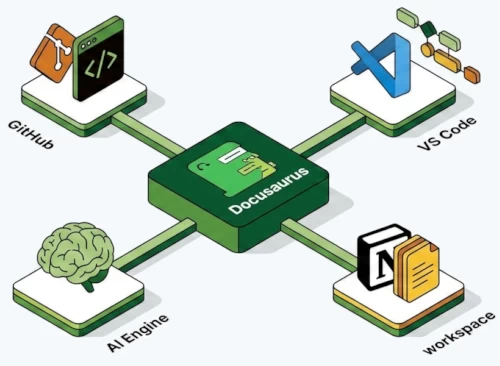
A technical writer's toolset becomes a strategic decision — one that enables the creation of documentation that is attractive, always up to date, structured for generative engines, and capable of delivering a high level of service to the user.
1️⃣ Docs‑as‑Code & Versioning
GitHub/GitLab + SourceTree
Git is the foundation. Secure storage, versioning, reviews, CI/CD — documentation evolves like code, with the same expectations for quality, traceability, and collaboration.
SourceTree gives me a clear, visual view of branches, diffs, and history. A visual comfort that speeds up understanding and reduces errors.
Versioned, traceable, structured documentation is far more usable by AI tools — for writing, reviewing, analyzing, or generating content.
2️⃣ Documentation Sites
Docusaurus
I've been building documentation sites for years, and using SSGs since 2019. In 2026, Docusaurus has become the backbone of my documentation workflow.
In the age of AI, a documentation site is no longer just a reading surface — it's a structured knowledge source, meant to be understood by humans and by generative engines.
Docusaurus allows me to:
- design the documentation architecture
- write content in Markdown
- customize layouts and page structure
- internationalize content
- offer multiple access paths (tags, links, search)
- manage versions
- optimize SEO and GEO
- publish a clean, fast, AI‑friendly static site
I also added structured data to every page of my site (more on this in my next blog post), and I was able to customize Docusaurus to define all the metadata required for SEO. This flexibility is a major advantage when preparing documentation for generative indexing.
Documentation is no longer a static deliverable. It becomes a strategic asset — readable, indexable, and reusable by AI systems.
3️⃣ The IDE
Visual Studio Code + extensions
The developer's environment is also the natural environment for a docs‑as‑code technical writer.
VS Code, connected to Git, enriched with extensions and now with AI, is my main workshop. It's where:
- content
- structure
- versioning
- automation
- metadata
- and AI assistance
all come together.
Working in an IDE naturally aligns documentation with the workflows AI understands and optimizes best.
4️⃣ AI
ChatGPT / Copilot / Claude Code + DeepL
AI isn't a gadget — it's a team. It acts as an accelerator, a partner, a thinking space.
My usage is intentionally differentiated:
-
ChatGPT / Copilot: brainstorming, structuring, writing, rewriting, challenging ideas.
-
Claude Code: documenting APIs, analyzing code, understanding complex interfaces.
-
DeepL and/or ChatGPT: translation, localization, harmonization.
AI is far more effective when documentation is readable, structured, contextualized, and versioned — exactly what docs‑as‑code provides.
AI amplifies the technical writer's skills and gives a solo worker the power of a full team.
5️⃣ Project Management
Notion
Notion is my cockpit. I use it for:
- roadmaps
- editorial backlog
- planning
- notes
- self‑training
- CRM
Documentation is a product. It deserves real project management — with clarity, prioritization, and continuous oversight.
Conclusion
The technical writing profession is evolving rapidly under the influence of AI.
In 2026, it's no longer just about writing good guides. It's about embracing docs‑as‑code, web publishing, CI/CD, content architecture, SEO/GEO, multilingual workflows, AI as an assistant, AI as a consumer of documentation.
👉 The toolset is no longer a toolbox.
It's a work ecosystem, designed to produce documentation that is useful, clear, structured, readable by everyone — including AI — and a true communication asset for the company.
This website is, in fact, the perfect illustration of this 2026 toolset in action.