How I Personally Did the SEO of My Website

Implementing real-world SEO on a Docusaurus website, with GEO in mind
SEO is one of those topics everyone talks about, but few actually practice end-to-end on a real website. It is a real profession with real skills, and not something that can be improvised by simply stuffing the <head> with keywords.
When I built CoffeeCup.tech, I didn't want SEO to remain a theoretical checklist (as I confess, I did in my previous Hugo Coffee Cup website).

Why I Took SEO Seriously
I wanted measurable results: better visibility on Google, clearer positioning, and a website that could be correctly understood not only by humans, but also by search engines — and now, by generative engines.
This article is a practical return of experience on how I personally implemented SEO on a Docusaurus website, what worked, what was trickier than expected, and why it matters far beyond "ranking higher".
Why SEO Still Matters
And not only for Google
Yes, the first motivation was obvious:
👉 improve my ranking on Google.
But SEO matters for much more than that:
-
Discoverability: if your content is not structured and described correctly, it simply does not exist for search engines.
-
Credibility: clear snippets, consistent titles, and coherent metadata directly influence trust.
-
Content clarity: writing for SEO forces you to clarify what each page is about.
-
Future-proofing: SEO is now the foundation of GEO (Generative Engine Optimization). If machines don't understand your content today, LLMs won't tomorrow.
SEO is no longer optional. It's the entry point to being readable by any automated system.
From Theory to Practice: "From SEO to GEO"
In line with my general approach — after theory, let's practice — I deliberately applied what I explain on my page "From SEO to GEO" directly to CoffeeCup.tech. That page is not marketing fluff. It's the conceptual backbone of my SEO decisions:
- SEO as structured meaning, not keyword stuffing
- Documentation as a data source
- Pages as entities, not just URLs
CoffeeCup.tech is my live experiment of these ideas.
SEO in Docusaurus: Much More Than <head>
One of the biggest misconceptions about SEO in Docusaurus is thinking that everything happens in the <head>.
 <Layout
      title={`Hello from ${siteConfig.title}`}
      description="Description will go into a meta tag in <head />">
      <HomepageHeader />
      <main>
        <HomepageFeatures />
      </main>
    </Layout>
In reality, SEO is distributed everywhere:
<head>tags (title, meta description, Open Graph, Twitter cards)- Front matter in Markdown files (title, description, tags, image)
- Sidebar labels and doc IDs
- URL structure and slugs
- JSON-LD structured data*
- Theme configuration and overrides
Some of these are obvious. Many are not. It's up to you to add them.
Docusaurus is an excellent SSG for SEO, but:
- You need to search for the hooks
- and sometimes extend or customize the theme
SEO in Docusaurus is powerful — but not plug-and-play. Which makes it more fun. 😊
SEO Is Tricky: Rules, Limits, and Reality
SEO is also full of traps.
A good example: meta descriptions length.
You might think: "165 characters is the recommended length."
In practice:
- Google usually prefers 150–160 characters
- 165 is already too long in many cases
- beyond that, your snippet gets truncated
As a result, you have to synthesize your ideas as much as possible, stay meaningful, and avoid keyword stuffing — which is surprisingly challenging.
And this is not cosmetic.
This is about SEO objectives:
- Clear messaging
- Controlled snippet rendering
- Avoiding meaningless ellipses
SEO has strict, sometimes invisible rules, and they matter if you want consistent results.
Testing, Measuring, Iterating
SEO without tools is guesswork.
My toolset at the time included:
-
SEONaut, to audit structure, metadata, and technical consistency. Points out more or less critical issues, really useful.
-
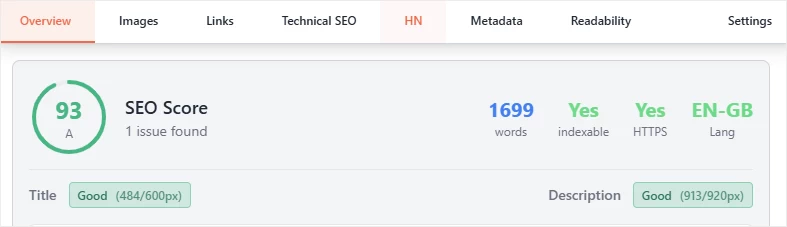
Cuik SEO (browser extension), for fast page-level checks and snippet previews. Delivers a score, which becomes a kind of personal Grail by the end.
This is an example of the SEO Score of one of my pages (not all rank A, most rank B because of points over which I have little control):
These tools helped me:
- Detect missing, duplicated, long, or short descriptions
- Validate character limits for the snippets
- Spot incoherences in heading order (the Blog list page 😣)
- Iterate fast
Good SEO is incremental. You test, adjust, re-test.
What I Took Away from This Experience
Doing SEO on CoffeeCup.tech reinforced a few key convictions:
-
SEO is not a "final step", it's a design constraint, it's the hidden part of the iceberg, just as important as the part visible to the user.
-
Docusaurus gives you strong SEO foundations — if you use and customize them.
-
Writing good metadata forces better thinking.
-
SEO today is already GEO-ready SEO.
Most importantly:
SEO is not about gaming algorithms. It's about making meaning explicit.
And that philosophy fits perfectly with technical documentation as a data source.
What This Means in Practice
If you're building a documentation site, a technical blog, or a knowledge base, SEO is not a separate discipline — it's part of how you structure and express knowledge.
That's exactly what I aim to demonstrate with CoffeeCup.tech ☕
* Stay tuned: I also made my own structured data for GEO. 😉